

RWHIZ shares cooperation experiences and digital technologies at side events during the 48th session of the World Heritage Committee.
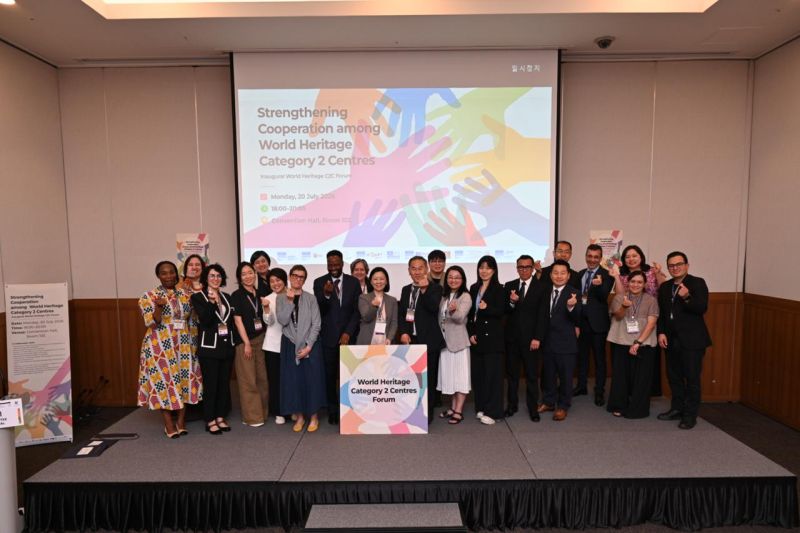
During the 48th session of the UNESCO World Heritage Committee held in Busan, Republic of Korea, the Regional World Heritage Institute in Zacatecas (RWHIZ) directly participated in two side events—in addition to one organized by the Institute itself—aimed at strengthening international cooperation and sharing experiences regarding World Heritage conservation and management.
RWHIZ participated in the launch of the Forum of World Heritage-related Category 2 Centres, an initiative led by the International Centre for the Interpretation and Presentation of World Heritage Sites (WHIPIC) in the Republic of Korea and organized in coordination with other World Heritage-related Category 2 Centres, including RWHIZ.
Prior to this event, four preparatory meetings were held among the participating centres to discuss the Forum’s purpose, principles, operations, and initial lines of work. RWHIZ took part in this process, which builds upon the dialogue fostered among Category 2 Centres in recent years—particularly following declarations adopted during their coordination meetings, such as the 2025 Zacatecas Declaration.
Furthermore, the Institute participated in a side event organized by the International Centre on Space Technologies for Natural and Cultural Heritage (HIST)—a Category 2 Centre based in China—focused on analyzing the use of artificial intelligence and other digital technologies in World Heritage conservation. At this event, RWHIZ presented the experience gained in Mexico, Central America, and the Caribbean through the Training Program on Accessible Digital Technologies for World Heritage Documentation.
The presentation highlighted that incorporating tools such as artificial intelligence requires the prior availability of adequate data and information, as well as the capacity to generate, organize, and interpret them. The experience underscored the potential of photogrammetry, drones, and 3D modeling as accessible tools to support documentation, monitoring, conservation, and management processes, and to generate digital information that can underpin the progressive adoption of new technologies for World Heritage protection.
RWHIZ’s participation in both events helped strengthen cooperation with other Category 2 Centres and specialized institutions, share experiences from Mexico, Central America, and the Caribbean, and contribute to the international exchange of knowledge and best practices regarding World Heritage conservation and management.


