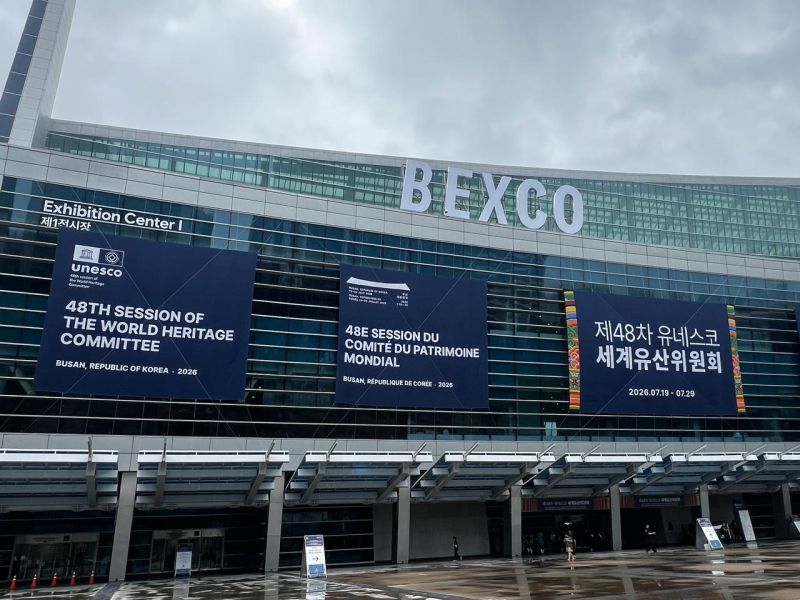
RWHIZ presents its 2025–2026 progress to the UNESCO World Heritage Committee.
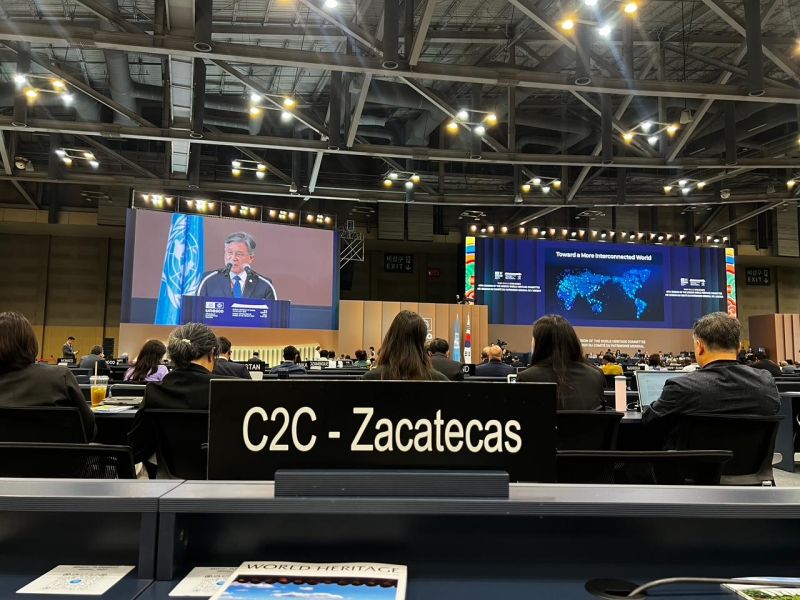
During the 48th session of the UNESCO World Heritage Committee, held from July 19 to 29 in Busan, Republic of Korea, the Regional World Heritage Institute in Zacatecas (RWHIZ)—a UNESCO Category 2 Centre—presented its report on key actions and results achieved during the 2025–2026 period.
Carlos Augusto Torres Pérez, the Institute’s Director General, outlined—under Agenda Item 6B—the initiatives undertaken to support Mexico, Central America, and the Caribbean, particularly in the areas of capacity building, access to technical knowledge, digital documentation, outreach, and regional and international cooperation.
Key achievements highlighted included the Training Program on Accessible Digital Technologies for World Heritage Documentation; since 2023, this program has trained over 120 specialists and contributed to the creation of more than 35 three-dimensional models of sites inscribed on the World Heritage List. Notably, documentation exercises were carried out in Panama and Mexico in 2026.
The report also presented progress on the subregional cooperation agenda, including the holding—in coordination with Guatemala’s Ministry of Culture and Sports—of the First National Meeting of World Heritage Managers, which yielded lines of work regarding impact assessments, photogrammetry, and outreach.
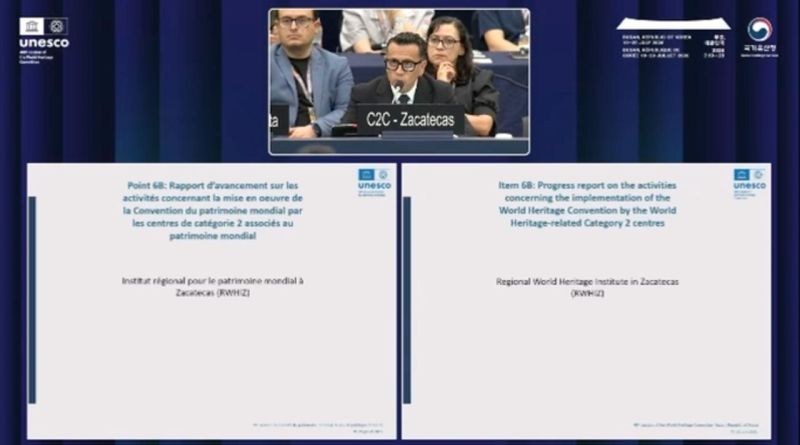
Regarding international cooperation, the report noted the signing of a Memorandum of Understanding with the International Centre on Space Technologies for Natural and Cultural Heritage (HIST), based in China, as well as continued collaboration with the International Centre for the Interpretation and Presentation of World Heritage Sites (WHIPIC) of the Republic of Korea.
Efforts to reduce barriers to accessing technical knowledge in Spanish were also highlighted. During the reporting period, the translation of the *Manual and Toolkit on Impact Assessments in a World Heritage Context* was completed, a project carried out in collaboration with the Government of Chile, Spain’s Ministry of Culture, ICCROM, and the World Heritage Centre. The Spanish version of the *Operational Guidelines for the Implementation of the World Heritage Convention* was also finalized.
In the realm of communication and outreach, the Institute presented the consolidation of *Ecos del Patrimonio* (Echoes of Heritage), a project comprising a specialized magazine—the first issue of which is currently in circulation—and a podcast featuring episodes produced in Mexico and Guatemala.
The presentation of the report to the World Heritage Committee provided an opportunity to highlight the RWHIZ’s contribution to the implementation of the 1972 Convention and to reaffirm its commitment to working with the World Heritage Centre, States Parties, advisory bodies, and other Category 2 Centres.