

Publication of the International Colloquia of the Camino Real de Tierra Adentro 2022 and 2023. Zacatecas - Aguascalientes
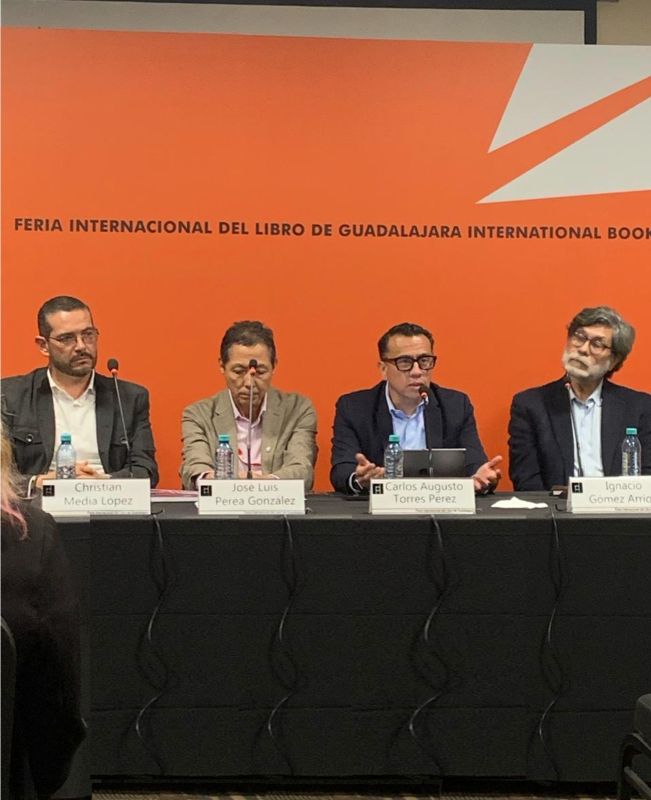
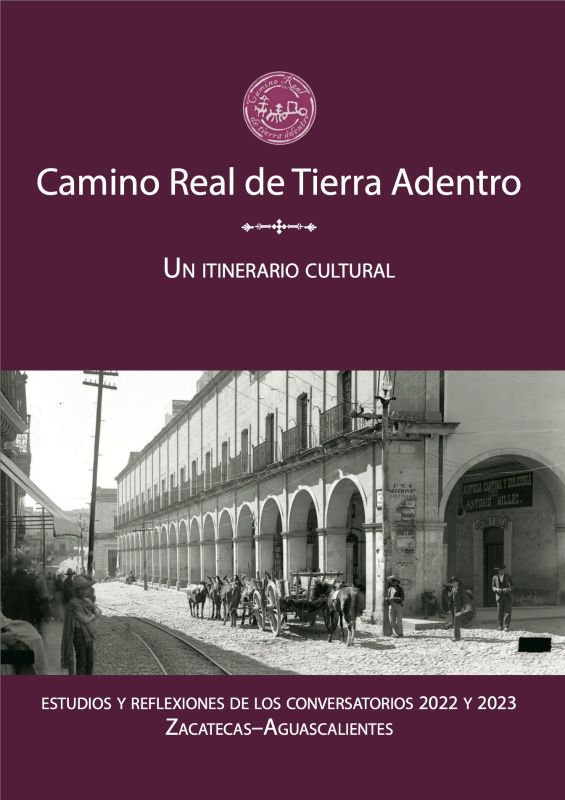
The Regional Institute of World Heritage in Zacatecas (RWHIZ), through its Director General, Carlos Augusto Torres Pérez, participated in the presentation of the book “Camino Real de Tierra Adentro: A Cultural Itinerary. Studies and Reflections from the 2022 and 2023 Conversations. Zacatecas–Aguascalientes,” which took place as part of the Guadalajara International Book Fair (FIL) 2025 program.
The presentation of this work, coordinated and edited by INAH, included commentary from José Luis Perea González, Technical Secretary of the National Institute of Anthropology and History (INAH); Christian Jesús Martín López Velarde, Director of the INAH Center in Aguascalientes; and Luis Ignacio Gómez Arriola, expert architect from the INAH Center in Jalisco.
The volume comprises five thematic sections that offer a broad, comparative, and multidisciplinary view of the Camino Real de Tierra Adentro (CRTA) and its connection to other cultural itineraries in Latin America. Its chapters integrate specialized studies, applied research cases, and theoretical reflections derived from the 2022 and 2023 discussions held in Zacatecas and Aguascalientes.
The first section, conceived as a conceptual gateway to the book, demonstrates that cultural routes are transnational expressions where history, territory, and collective memory converge, and situates the Camino Real de Tierra Adentro within a broader continental framework. Examples of heritage routes and road systems in Latin America and the Caribbean are presented, allowing for a comparison of management models, research approaches, and declaration processes.
This section highlights how dialogue with other routes allowed for the recognition of the importance of community participation and an appreciation of the diversity of existing approaches to the interpretation, protection, and social use of heritage.
The second part focuses on built heritage: its identification, documentation, and study along different sections of the Camino Real de Tierra Adentro. The chapters address engineering works, viceregal architecture, and historical sites that constitute true points of articulation along the route and that shape the materiality of the Camino Real. This section is particularly valuable, as it allows for an appreciation of the route's architecture, its physical traces, and its current state of conservation.
The third section delves into the very traceability of the route: its structure, its branches, its historical trails, and the remaining sections of the road infrastructure. All of this reveals the Camino Real as a landmark inscribed on the landscape, whose full understanding is only possible through interdisciplinary work.
The fourth part is dedicated to analyzing the framework of cooperation, governance, and public policies that influence the conservation of the Camino Real. The texts explore the relationship between Mexican institutions, international organizations, and various local stakeholders.
Finally, the fifth part offers a conceptual and methodological perspective on the notion of a cultural route, heritage research processes, and the cataloging mechanisms associated with the CRTA (Central Route of the Camino Real). This section concludes the book with insightful reflections, highly useful for researchers, managers, academics, and authorities involved in the management of cultural routes and the design of heritage policies.
During their remarks, the presenters emphasized the importance of preserving, through this publication, the record of these colloquia, which originated in November 2022 in Zacatecas as part of the activities commemorating the 50th anniversary of the UNESCO Convention Concerning the Protection of the World Cultural and Natural Heritage. They also underscored that these meetings have grown stronger year after year thanks to close and enthusiastic inter-institutional collaboration between RWHIZ–CC2 UNESCO and INAH.