

They analyze progress, challenges and opportunities in the preservation of Industrial Cultural Heritage
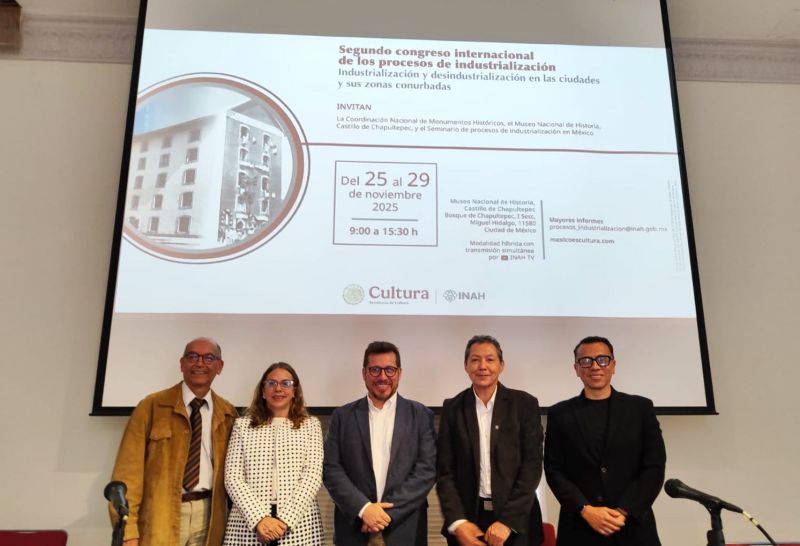
During the 2nd International Congress on Industrialization Processes held at the National Museum of History “Chapultepec Castle” in Mexico City, the discussion “Industrial Cultural Heritage and its Enhancement” took place.
The panel consisted of José Luis Perea González, Technical Secretary of the National Institute of Anthropology and History (INAH); Valeria Valero Pie, National Coordinator of Historical Monuments at INAH; Arturo Balandrano Campos, Director of Sites and Monuments at the Ministry of Culture; and Carlos Augusto Torres Pérez, Director General of the Regional Institute of World Heritage in Zacatecas (RWHIZ).
During the discussion, the National Coordinator of Historical Monuments defined Industrial Heritage as the set of assets, spaces, practices and memories related to the productive practices that arose as a result of industrialization, considering them cultural assets of a society because they document the economic, technological, social and territorial transformation that occurred mainly between the 18th and 20th centuries, mentioning that to date, in Mexico there are almost 3,000 monuments and historical sites cataloged under this typology.
For his part, José Luis Perea mentioned that, although the concept of industrial heritage does not exist as such in the 1972 Federal Law on Monuments and Archaeological, Artistic, and Historical Zones, the National Institute of Anthropology and History (INAH) has been developing a series of actions and establishing a series of provisions for its research, protection, and conservation, especially for those properties built between the 16th and 19th centuries, which are considered historical monuments by legal designation. He also shared some experiences in the protection and restoration of industrial heritage properties, particularly in northern states like Sonora and Chihuahua, to exemplify the types of connections that can be forged to promote and highlight the significance of industrial heritage in our history and culture. He also emphasized the importance of the associated intangible heritage, linked through traditions of work, organization, and commerce, which broaden our understanding of history and community life.
Arturo Balandrano noted that there are also vestiges of industrial activity dating back to the pre-Hispanic period, such as Cerro de las Navajas near Teotihuacan, where obsidian was worked, and the mezcal distilleries in Oaxaca. He also emphasized the need to protect the material remains of 20th-century industrial heritage, as they are not currently considered in the Federal Law due to their age. He cited several important examples, such as the oldest power plant in the country in Necaxa, Puebla, and the industrial complex of the sugar mills in Ahome, Sinaloa, among others. He pointed out that the importance and value of industrial heritage must be recognized first and foremost by the residents of the areas where it is located, as it has been shown that when this occurs, they are the ones who lead the initiatives for its protection and preservation, considering it part of their collective memory, as in the case of the gunpowder factory near the town of Santa Fe in Mexico City.
For his part, Architect Carlos Augusto Torres addressed the topic from an international perspective through the application of the UNESCO World Heritage Convention for the identification and protection of Industrial Heritage as one of the typologies that, due to its historical and cultural role, has represented many of the great changes in the history of humanity, giving it a status of Outstanding Universal Value worthy of being preserved for the knowledge of future generations.
He also mentioned that the international community's interest in protecting industrial heritage emerged towards the end of the 1970s and noted the properties inscribed to date under this category on the World Heritage List in the Mexico, Central America and Caribbean region, highlighting the Valley of the Sugar Mills and the first Coffee Plantations in Southeast Cuba, as well as the mines adjacent to the historic city of Guanajuato and the Old Industrial Facilities of Tequila as part of the Agave Landscape in Mexico, also mentioning the work that has been done in recent years in countries such as Barbados, Guatemala and the Dominican Republic to incorporate cultural properties related to Industrial Heritage into their Tentative Lists.
Finally, the panelists analyzed the opportunities presented by the enhancement of Industrial Heritage, highlighting that, as established by the Charter of Nizhny Tagil, it has social value and as such, can provide an important sense of identity, so its potential to generate a positive social, economic and cultural impact in communities through sustainable rescue and revitalization projects can be the way to ensure and promote its preservation.