

The RWHIZ participates in the National Workshop to Strengthen the Management of World Heritage Archaeological Zones in Mexico
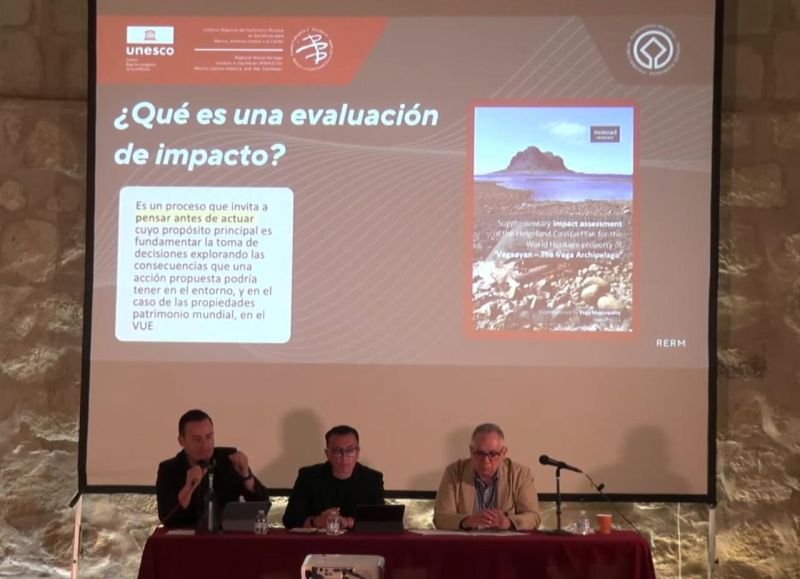
The Regional World Heritage Institute in Zacatecas (RWHIZ), a Category 2 Center under the auspices of UNESCO, participated in the “Workshop for Updating the Management, Conservation, and Sustainability Plans for Mexican Archaeological World Heritage Sites,” held on November 18 and 19 in Oaxaca, Mexico, by the National Institute of Anthropology and History (INAH) and the UNESCO Office in Mexico, with the contribution of the Kingdom of Saudi Arabia.
The RWHIZ was represented by its director, Carlos Augusto Torres Pérez, and by Raúl E. Rodríguez Márquez, collaborator of the Category 2 Center, who presented the usefulness of the Guide and Toolbox for Impact Assessments in World Heritage contexts, prepared in 2022 by UNESCO, ICCROM, IUCN and ICOMOS, not only to respond to projects that may affect the Outstanding Universal Value (OUV) of the properties, but also as an instrument to strengthen daily management through the understanding of attributes, values, environments and territorial dynamics.
The RWHIZ contribution underscored the usefulness of impact assessments for anticipating risks, comparing alternatives, and fostering informed decisions based on the complexity of sites and the clear distinction between values and attributes—fundamental components of the European Value of Sites (EVS).
The workshop brought together the directors of the eleven Mexican archaeological sites inscribed on the World Heritage List, along with technical teams from the National Institute of Anthropology and History (INAH), UNESCO specialists, and representatives from the National Commission of Natural Protected Areas (CONANP). This initiative is part of UNESCO's effort to strengthen capacities in Latin America and the Caribbean, incorporating a vision of environmental, economic, and cultural sustainability into management practices, as well as broader community participation.
During the closing session, the institutions agreed on the importance of consolidating a more dynamic, open, and coordinated approach to heritage management. They also agreed to continue this work, including through support from the Category 2 Center located in Zacatecas, by holding a workshop in 2026 on the application of the Guide and Toolkit for Impact Assessments in World Heritage contexts.
This participation allowed RWHIZ to offer technical assistance and promote a tool that strengthens the effective implementation of the World Heritage Convention, which is an essential part of its mission as a Category 2 Center under the auspices of UNESCO.